


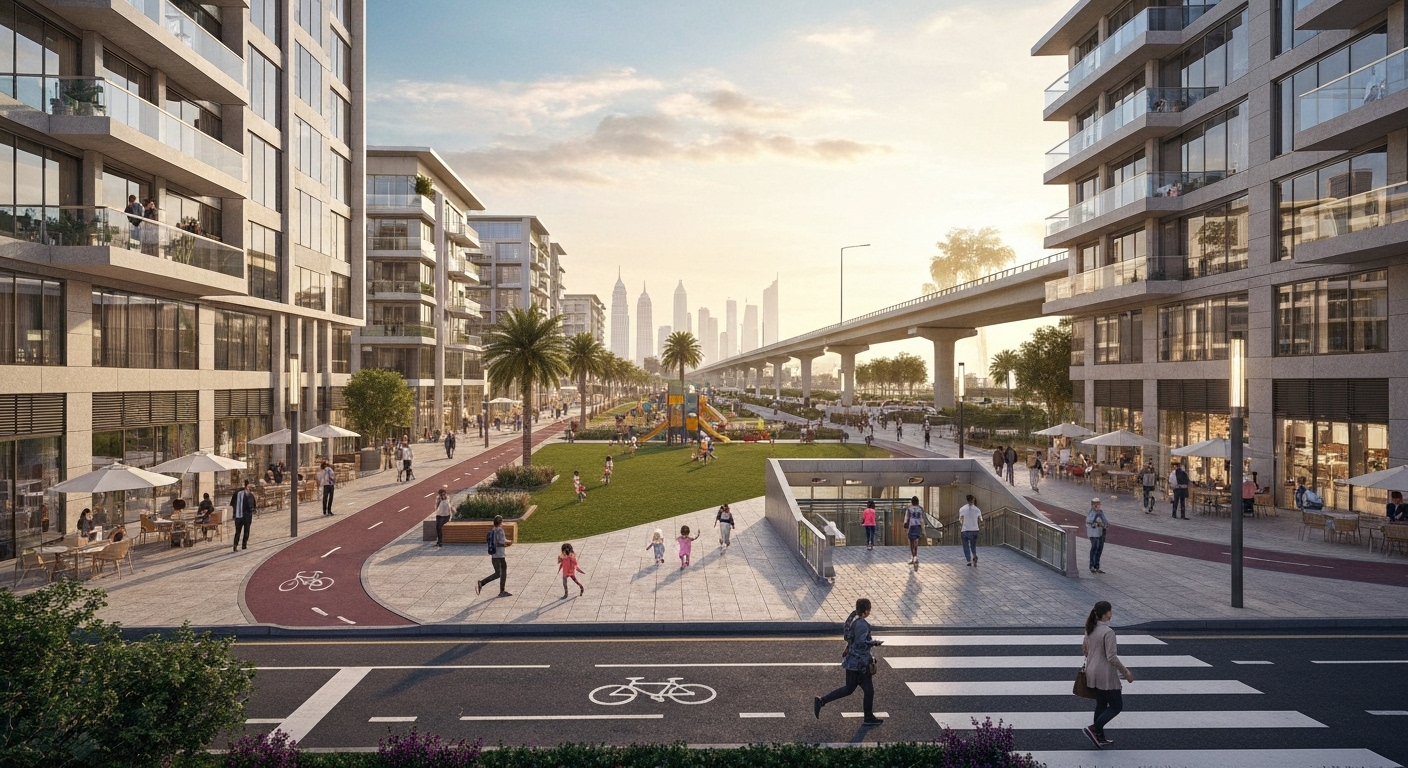
Prospective buyers and investors often ask: What is the walkability score of areas like JVC vs Town Square in Dubai, and how do these scores truly impact daily life and property value? This article provides a detailed, local comparison of both neighborhoods, focusing on walkability scores, everyday convenience, and investment potential – all within Dubai’s fast-evolving real estate market.
Understanding Walkability: More Than Just Footpaths in Dubai
In Dubai, walkability refers to how easily residents can move around a neighborhood on foot, accessing grocery stores, schools, parks, and essential services without relying on a car. A high walkability score means improved quality of life, stronger community bonds, and, increasingly, higher property values. For property investors, walkability is also linked to rental demand and long-term appreciation, especially as Dubai’s urban planning shifts toward human-centric, pedestrian-friendly environments.
JVC: A Closer Look at its Walkability Profile
Jumeirah Village Circle (JVC) is well-known as a vibrant, family-friendly community. Its design integrates green spaces, footpaths, and pedestrian walkways, encouraging walking for daily errands. Residents of JVC enjoy convenient access to a wide range of amenities: retail outlets, supermarkets, schools, and healthcare facilities are thoughtfully dispersed throughout the community.
JVC’s street layout offers wide, shaded sidewalks and paved jogging trails that wind past parks and play areas. Safety is a clear priority, with many pedestrian crossings, dedicated cycling lanes, and well-lit streets. The proximity of JVC to both Sheikh Zayed Road and key metro and bus lines supports car-free mobility, though most day-to-day necessities can be reached within a 10-15 minute walk for many residents.
Realistically, JVC scores above average on Dubai’s walkability scale, typically ranging in the mid- to high-70s out of 100 based on local access to shops and services. Although not every pocket offers the same density of amenities, the majority of homes benefit from JVC’s integrated urban design.
Town Square: Evaluating its Pedestrian-Friendly Features
Town Square, located further south of Dubai, positions itself as a self-sustained community built with walkability in mind. Its master plan features interconnected pedestrian paths that link residential zones directly to a vast central park, plazas, cafes, shops, and recreational facilities.
The neighborhood highlights “15-minute living,” where essential services – from pharmacies to nurseries and fitness centers – are never far from home. Wide boulevards, landscaped walkways, and safe crossings reinforce the appeal for families with young children, as well as professionals who favor active lifestyles.
While Town Square is newer compared to JVC, it benefits from planning lessons learned in Dubai’s urban evolution. The neighborhood’s walkability score often rivals or slightly surpasses JVC, generally ranging from the high-70s to low-80s out of 100. The main advantage lies in the close clustering of amenities and direct pedestrian routes through the community.
Walkability in Action: Daily Life Examples
In JVC, a resident could easily walk their children to one of several schools, pick up groceries, and stop for coffee, all along landscaped pathways within a few blocks. In Town Square, a similar experience is available, but with a more resort-like atmosphere – open plazas, event spaces, and larger parks are within short walking distance from most homes.
JVC vs. Town Square: A Head-to-Head Walkability Score Analysis
Both JVC and Town Square excel in pedestrian connectivity, but their approaches differ. JVC’s organic development has led to some variation in walkability block to block, while Town Square’s modern infrastructure and master planning mean a greater consistency across the district.
In practical terms, Town Square edges ahead in walkability score thanks to its focused design, with many residents able to accomplish all daily tasks on foot. JVC, meanwhile, combines walkable convenience with unmatched city connectivity, being minutes from central hotspots like Dubai Marina and the Dubai Mall.
For investors, a high walkability score translates into strong rental appeal. Both neighborhoods are popular with young families and professionals, groups that increasingly prioritize car-free lifestyles, green spaces, and community infrastructure.
Beyond the Score: Practical Walkability for Residents and Investors
A walkable community in Dubai is more than a number – it’s a driver of lifestyle and real estate value. Both JVC and Town Square deliver on this front, offering a genuine alternative to car-dependent living and promising solid long-term growth.
The Future of Walkability: How Danube Properties is Shaping Dubai’s Urban Landscape
Danube Properties continues to play a leading role in enhancing Dubai’s walkable neighborhoods, backing developments in strategic, highly connected areas like JVC and beyond. As the city advances its focus on sustainability and active living, walkability will remain at the core of value creation for both residents and investors.
In summary, the walkability scores of JVC and Town Square rank among the highest in Dubai, directly benefiting daily life and driving property value upwards.