


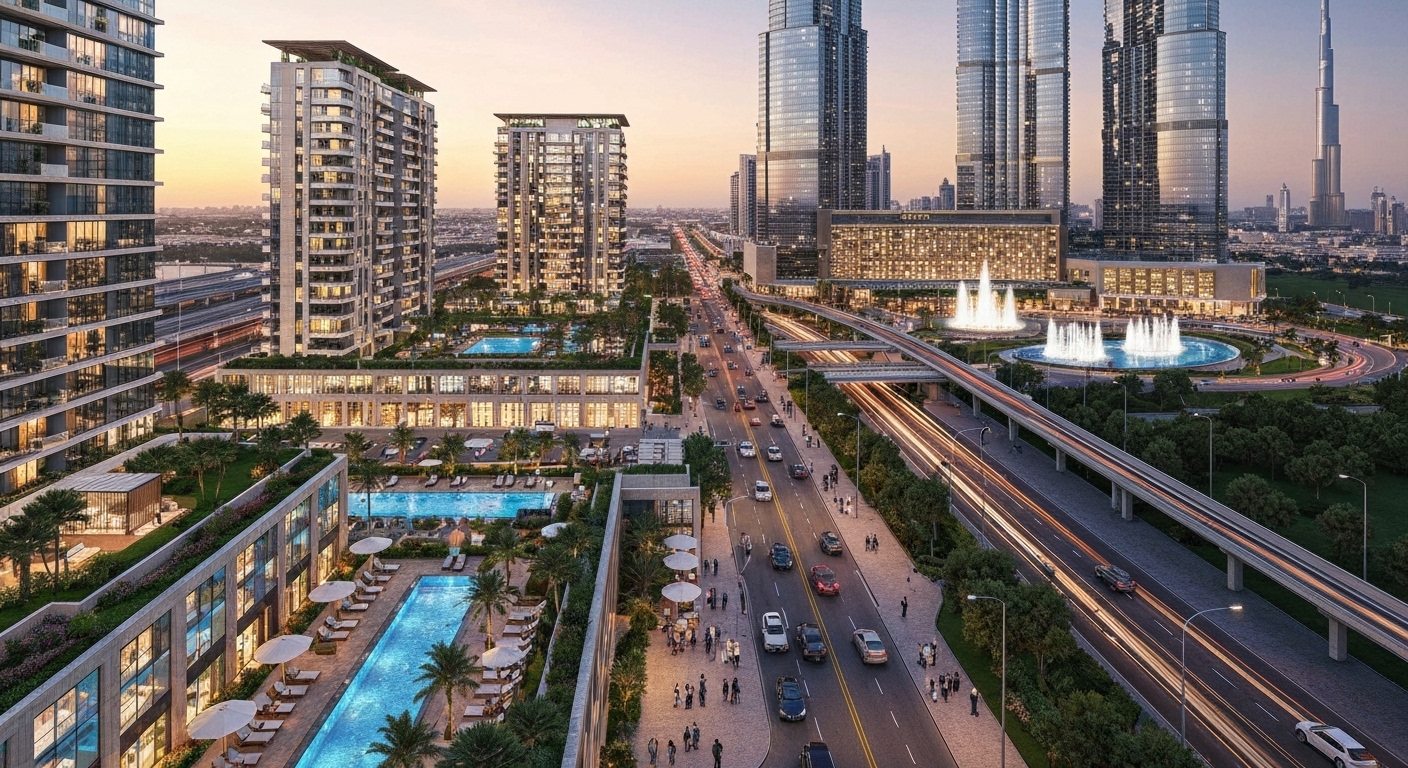
Dubai’s real estate market presents a compelling investment landscape in 2025, with rental yields consistently outperforming global markets at 6-10% compared to just 2-3% in major international cities. For investors seeking sustainable long-term value, the choice between Danube Properties and Emaar Properties represents a strategic decision that could define their investment trajectory for years to come.
Understanding Long-Term Value in Dubai Real Estate
Long-term value in Dubai real estate extends beyond immediate price appreciation. The market fundamentals remain robust, with an 18% year-over-year value increase in 2024 and a steady 3.7% growth in Q1 2025. Transaction volumes have surged by 82% compared to 2023, while a supply shortage continues to support property values, with only 30,200 residential units delivered in 2024.
The Dubai market’s strength lies in its regulatory framework and transparency. As a compliance-oriented market governed by the Real Estate Regulation Authority, investors benefit from protection and accountability that reinforces long-term value stability. Additionally, properties valued over AED 2 million qualify investors for long-term residency options, creating dual benefits of capital growth and lifestyle security.
Danube Properties: A Deep Dive into Value Proposition
Since launching into real estate in June 2014 with a AED 500 million townhouse project at Al Furjan, Danube Properties has established itself as the UAE’s pioneer in affordable luxury development. The company’s portfolio has grown to encompass 3,680 units valued at over AED 3.14 billion, spanning projects like Glitz Residence, Starz, Glamz, Miraclz, Resortz, Bayz, Jewelz, and Lawnz.
Danube’s value proposition centers on accessibility and innovation. Their signature 1% monthly payment plan democratizes luxury real estate investment, with properties starting from AED 550,000. Recent launches like Gemz, a $95.3 million residential project with unique convertible layouts, exemplify their approach to affordable luxury with 30 premium amenities and pyramid-shaped architecture.
The developer’s strategic focus on rapid market response has proven highly effective. Projects such as Pearlz, Jewelz, and Lawnz demonstrated exceptional market reception, often selling out within days of launch. This success stems from strategic inventory management, attractive payment structures, and properties designed for both immediate livability and long-term appreciation.
Emaar Properties: Evaluating Their Contribution to Long-Term Value
Emaar Properties has long been synonymous with Dubai’s premium real estate sector, establishing itself through landmark developments and master-planned communities. Their contribution to long-term value traditionally rests on location premiums, established infrastructure, and brand recognition within the luxury segment.
However, the premium positioning often translates to higher entry barriers and potentially lower rental yields compared to emerging developers focusing on the affordable luxury segment. While Emaar’s developments command strong resale values, the initial investment requirements can limit accessibility for many investors seeking entry into Dubai’s property market.
Head-to-Head: Danube vs. Emaar on Key Investment Metrics
When analyzing key investment metrics, Danube Properties demonstrates competitive advantages in several crucial areas. Rental yields for Danube properties often align with market averages of 6-8% in emerging communities, while their innovative payment plans reduce investor capital strain during construction phases.
Danube’s rapid project delivery timelines typically range from two-and-a-half years, ensuring faster returns to market and reduced construction risk exposure. The company actively facilitates Golden Visa processes for qualifying investors, adding administrative convenience to the investment package.
Emaar’s strength lies in established locations and proven track records, but this often comes with premium pricing that can impact initial yield calculations. Their developments typically focus on higher-value segments, which may limit rental yield optimization compared to Danube’s affordable luxury positioning.
Analyzing Property Types and Locations for Enduring Value
Danube’s strategic focus on emerging communities with strong growth potential positions investors in areas likely to benefit from infrastructure development and community maturation. Their convertible layout innovations, such as transforming 1BHK units into 2BHK configurations, provide flexibility that adapts to changing market demands.
The developer’s emphasis on comprehensive amenity packages within affordable price points creates competitive rental appeal, supporting sustained occupancy rates crucial for long-term returns. This approach contrasts with ultra-premium developments where high service charges can erode net yields.
Future Outlook: Market Trends and Developer Strategies for 2025 and Beyond
Looking toward 2025 and beyond, market trends favor developers who can deliver quality at accessible price points. Dubai’s continued population growth and economic diversification support demand for affordable luxury properties that provide both lifestyle appeal and investment returns.
Danube’s established pipeline and proven ability to respond quickly to market demands position the developer advantageously for future opportunities. Their commitment to facilitating investor services, including residency applications, demonstrates an understanding of evolving investor needs in Dubai’s dynamic market.
Making Your Informed Investment Decision: Danube or Emaar?
For investors prioritizing accessibility, innovation, and strong yield potential, Danube Properties presents a compelling proposition. Their affordable luxury approach, flexible payment structures, and rapid market response create an attractive package for building long-term wealth through Dubai real estate.
While Emaar maintains its position in the premium segment, Danube’s strategic focus on emerging communities and investor-friendly terms offers superior entry points for those seeking to capitalize on Dubai’s sustained growth trajectory. The choice ultimately depends on investment capacity, risk tolerance, and long-term objectives within one of the world’s most dynamic property markets.